
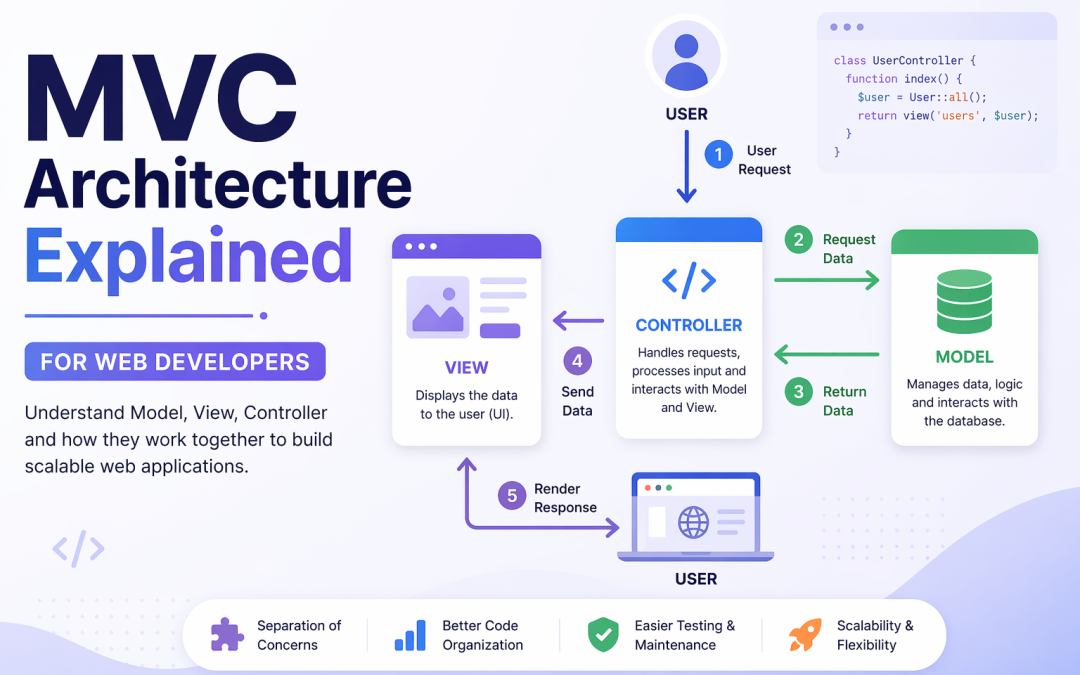
MVC Architecture Explained for Web Developers
When a web app is small, the structure doesn’t seem like a big deal. You can throw logic into a few files and connect to a database. Right afterwards, everything works. But as soon as the app grows with new features and users, problems start appearing. Suddenly, debugging becomes harder, and adding features takes longer. Then, you think about making a simple change, and it risks breaking something else.
This is where architecture steps in. Software architecture is about designing how different parts of your app communicate and evolve over time. Without a clear structure, projects become messy, fragile, and difficult to maintain.
One of the most widely used architectural approaches in web development is MVC. It’s a pattern designed to separate responsibilities inside an app. This way, each part focuses on one job and does it well. Understanding MVC is a practical skill that helps developers build cleaner systems that are easier to manage.
By the end of this guide, you’ll understand what MVC is, how it works, why it matters, and how modern frameworks implement it in real-world applications.
What is MVC Architecture?
MVC stands for Model, View, and Controller. It’s a software design pattern used to structure apps by separating concerns. The core idea is simple: instead of mixing user interface code, business logic, and data handling in one place, you divide them into three distinct components.
Each component has its own responsibility:
- The model manages data and business logic
- View handles presentation and UI
- Controller processes input and coordinates actions
This separation allows developers to modify only one part of the app without affecting the others. This flexibility helps make MVC one of the most commonly used patterns in web development.
The Three Core Components of MVC
The MVC architecture has three components. Here is an explanation for what each component does:
Model.
The Model is here to represent the data layer of your app. It handles everything related to storing, retrieving, and manipulating data. This includes communicating with databases, applying business rules, validating inputs, and enforcing data constraints.
For example, in an e-commerce app and ride sharing platforms, the Model would manage product information, user accounts, and order records. It helps make sure that the data remains consistent and accurate regardless of how it’s accessed.
One important detail is that the Model doesn’t care how the data is displayed. Its job is strictly about logic and data integrity.
View
The View is the presentation layer. It’s responsible for what users see and interact with. This includes the interface, layout, and visual representation of data. Views take information from the Model and display it in a readable format, whether that’s HTML pages, JSON responses, or UI components.
If the Model is the brain of your app, the View is the face. It doesn’t process business logic or handle database operations. Instead, it focuses only on rendering your information clearly.
Views also capture user input. This would include form submissions or button clicks, and pass those interactions to the Controller for processing.
Controller
The Controller here acts as the intermediary between the Model and the View. It listens for user actions, processes requests, communicates with the Model, and determines which View should display the result.
Think of the Controller as a traffic manager when a user submits a request, like logging in or searching for a product. The Controller receives it, decides what needs to happen, asks the Model for data if necessary, and then sends the appropriate response back through a View.
Without Controllers, Models and Views would be tightly coupled. This phenomenon would make apps harder to maintain and scale.
What are the Benefits of Using MVC
There are several advantages of using the MVC architecture. This is why developers prefer it, too. In fact, in most website design and development services, development teams prefer to use MVC because of its pros.
Separation of Concerns
One of the biggest advantages of MVC is clarity. Because responsibilities are divided, the code becomes easier to read, understand, and debug. Developers can quickly locate where logic belongs instead of searching through tangled files.
This structure also reduces the chance of accidental side effects when modifying code.
Maintainability
Apps evolve over time. They have to. Developers add more features, and UI designs change. Performance optimizations become necessary. MVC makes these updates easier. This happens because changes in one layer rarely affect the others.
For instance, redesigning the user interface only requires updating the Views. The business logic and data layer remain completely untouched. This naturally reduces the development time and reduces risk.
Scalability
As apps grow, organization becomes critical. MVC provides a structured foundation that supports expansion. Teams can work on Models, Views, and Controllers simultaneously. The best thing is that they are able to do it without interfering with each other’s work.
This is especially valuable in large projects. Because multiple developers collaborate on different parts of the system. MVC proves to be a game-changer.
Testability
Testing is far simpler when components are isolated. Models can be tested for logic accuracy, Controllers for request handling, and Views for rendering behavior. Because each part is independent, automated tests can target specific functionality.
They do this very easily without requiring the entire system to run. This leads to more reliable software and faster debugging cycles.
Conclusion
MVC has genuinely stood the test of time. It is simple because it solves one of the biggest challenges in software development. This is managing complexity. By separating the app into distinct components, things become easier to understand and scale.
For developers, mastering MVC isn’t just about learning a random pattern. It’s about adopting a different mindset. One that prioritizes structure and clarity.
Recent Comments