
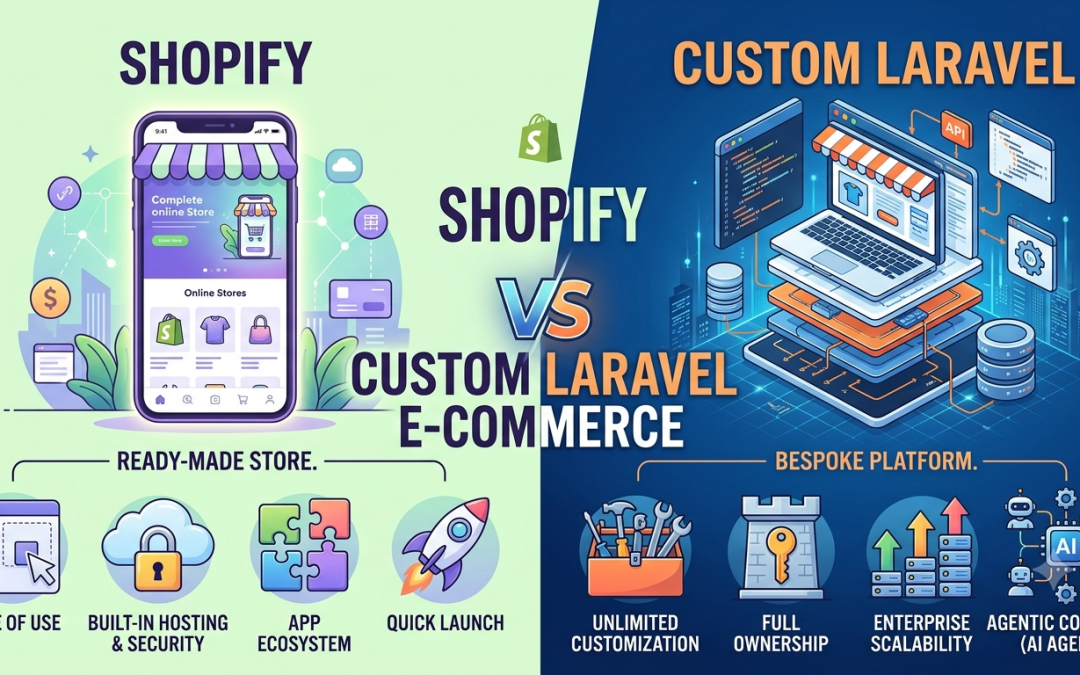
Looking for which platform will be best suited to your E-Commerce website? Whether to choose Shopify or Custom Laravel? Or Is Laravel better for enterprise eCommerce? Or Which platform gives full control over my website? So there are thousands that must be running behind your mind. Relax, we have got you covered. In this guide we have prepared detailed versions on how to choose the right platform according to your business requirements. Let’s explore!
Key Facts:
- According to Statista, Shopify consistently ranks as a premier global commerce platform with 11% of the global market share.
- Shopify Plus powers over 76,000 high-volume stores globally.
- Laravel commands over 61% of the global PHP framework market share.
- Shopify powers over 4 million active stores including premium brands like Tesla, and Gymshark.
- Laravel powers roughly 1.5 million live websites across various industries beyond just e-commerce.
- The typical mid-range Shopify store uses about 6–10 apps which can cost from $100-$500+ monthly for recurring fees. However, a Laravel developer creates these workflows directly in the system code, making it free of monthly recurring fees.
Best Platform for E-Commerce: Shopify or Custom Laravel
As you are oscillating between two, whether to go with shopify or it will work better when you choose custom laravel. Let’s understand these both with its key features, pros & cons and best suited for which businesses.
Shopify (Hero of All Platforms)
Shopify is a ready made Software as a Service solution designed for quick deployment, and allows full ownership to controllers for customization.
Key features:
- Easy store setup
- Secure hosting
- Built-in payment options
- Inventory management
- App store
- Mobile-friendly themes
- SEO & Marketing tools
- Analytics & Reports
Best Suited For:
- Startups and small businesses
- Direct to consumer brands
- Businesses that need a fast time to market
- Entrepreneurs with technical or coding expertise
Pros
- Quick and easy to set up
- No coding knowledge required
- Large ecosystems of themes and apps
- Built-in security and PCI compliance
- Secure hosting and automatic updates included
Cons
- Monthly subscription fees
- Advanced customization can be limited
- Less control over the platform backend and source code
- Platform dependency
- Transaction fees may apply with certain payment gateways
Custom E-Commerce (Bespoke Solution) Laravel
Custom Laravel is an open-source PHP development framework built from scratch for maximum customization, absolute ownership, and complex, non-standard business logic.
Why Businesses Choose Laravel
- Unlimited customization
- Full ownership
- Scalability
- Advanced integration
- No vendor lock in
Key Features
- Fully customized store design
- Custom Product & Inventory management
- Multiple payment gateway integrations
- Order & shipping management
- High performance and scalability
Pros
- Complete ownership of the website and source code
- Unlimited customization and flexibility
- Highly scalable for growing businesses
- No monthly platform subscription or vendor lock-in
Cons
- Higher initial development cost
- Longer development timeline
- Requires experienced Laravel developers
- Initial setup can be more complex than SaaS platforms
- Ongoing maintenance and updates are your responsibility
Cost Breakdown: Shopify vs Laravel
Understanding the total cost of ownership is essential when you are choosing an eCommerce platform. While Shopify has lower upfront costs, ongoing subscription fees, app expenses, and transaction charges can add up over time. A custom Laravel eCommerce website typically requires a larger initial investment but offers greater flexibility and control over long-term costs.
Here we list comparisons for costs, let’s delve!
Initial Development Cost
Shopify
- Low upfront investment
- Ready made themes and built in features
- More customization and add-ons will charge premiumly
- Pricing $300-$2000
Laravel
- Higher initial development cost
- Website built from scratch aligning with business requirements
- Ideal for businesses needing custom workflows, integrations, or unique customer experiences
- Pricing $3000-$20,000+
Monthly Subscription Costs
Shopify
- Monthly subscription plans
- Higher tier plans unlock additional features
- Subscription costs continue as long as your store is active
- Pricing $29-$299+/monthly
Laravel
- No platform subscription fees
- You only pay for hosting, maintenance and third party services
Hosting Costs
Shopify
- Hosting is included in your subscription
- No server management required
- Limited control over hosting environment
Laravel
- Requires separate hosting or cloud infrastructure
- Cost depends on traffic, storage, and server configuration
- Full control over performance optimization
- Pricing $20-$500+/monthly
Maintenance Costs
Shopify
- Automatic updates and security patches
- Minimal maintenance responsibility for store owners
- Lower ongoing technical management
- Pricing $0-$100/monthly
Laravel
- Requires regular framework updates, security patches, bug fixes, and server maintenance
- Costs vary depending on the complexity of the website and support requirements
- Pricing $100-$1000+/monthly
App & Plugin Costs
Shopify
- Large app marketplace
- Many advanced features require paid monthly apps
- Costs can increase as your business grows
- Pricing $20-$300+/monthly
Laravel
- Custom features are built specifically for your business
- No dependency on recurring app subscriptions unless you choose third-party services
Payment Gateway Charges
Shopify
- Supports multiple payment gateways
- Additional transaction fees may apply if you don’t use Shopify Payments (availability varies by region)
- Payment gateway processing fees still apply
Laravel
- Integrate any payment gateway of your choice
- No platform-imposed transaction fees
- Only gateway processing charges apply
Developer Costs
Shopify
- Lower developer involvement for standard stores
- Developer costs increase for advanced customization and private apps
Laravel
- Requires experienced Laravel developers for development, updates, and enhancements
- Higher initial development investment but complete flexibility
Scaling Costs
Shopify
- Upgrading plans and adding premium apps increases recurring costs
- Some advanced features may require third-party solutions
Laravel
- Scale infrastructure based on business needs
- Add new features without platform limitations
- Costs are tied to actual growth rather than subscription tiers
Which Businesses Benefit Most
Choose Shopify if you:
- Quick launch or deployments
- Have standard eCommerce requirements
- Prefer ready made solutions with minimal technical maintenance
- Want built-in hosting and security
Choose Laravel if you:
- Need complete control over features and architecture
- Require custom integrations with ERP, CRM, POS, or other enterprise systems
- Expect your platform to evolve significantly over time
- Want full ownership of your code and infrastructure
Final Thoughts
In the Shopify vs Laravel eCommerce debate, Shopify is best for quick launches and lower upfront costs, while the Laravel eCommerce platform is ideal for custom online store development and long-term scalability. Choose the best eCommerce platform for your business based on your growth goals, budget, and customization needs. Ready to Build a High-Converting Shopify Store? Hire dedicated Shopify developers to create secure, scalable, and conversion-focused eCommerce solutions tailored to your business.
Recent Comments